
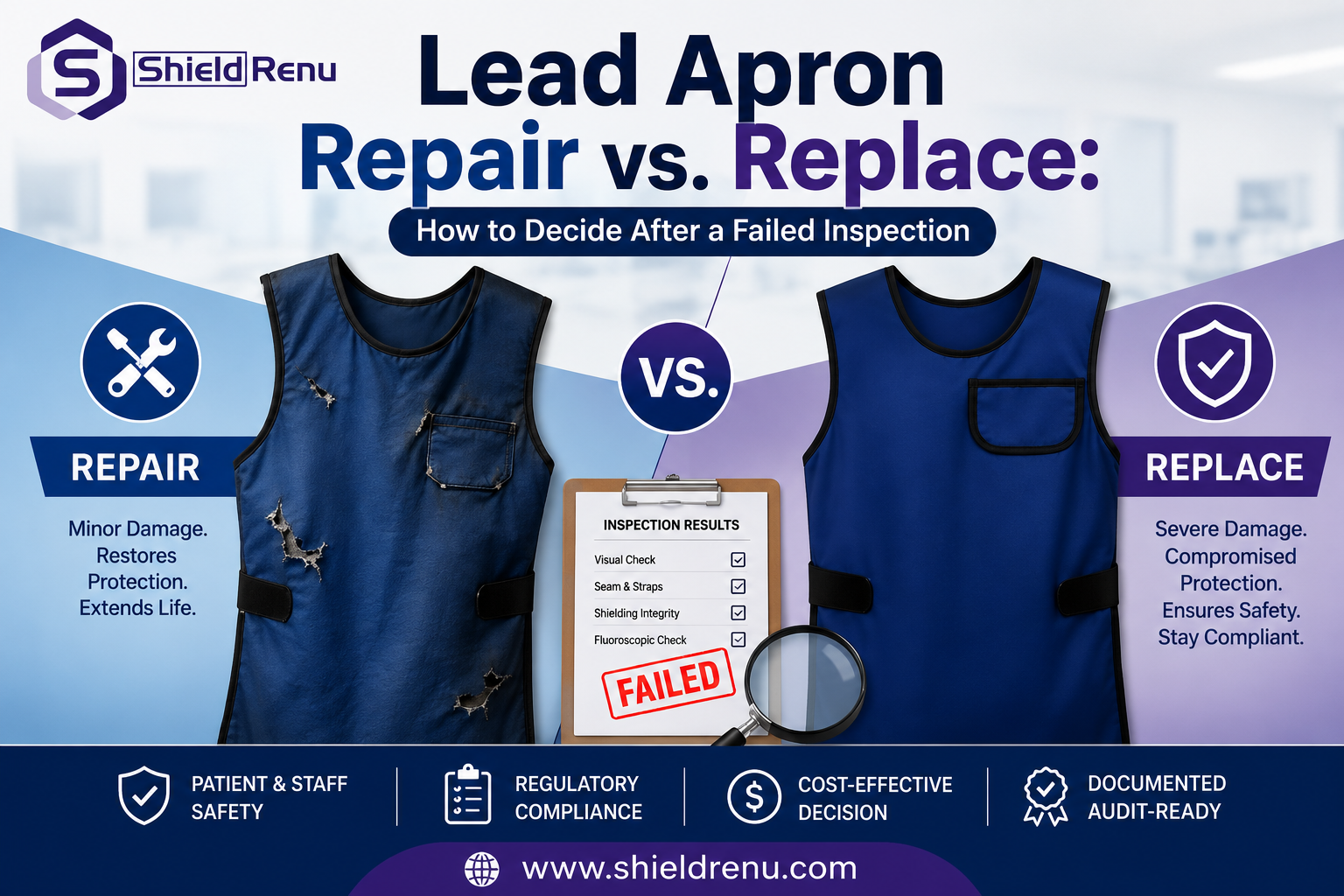
Your lead apron just failed inspection. Now what?
If your facility follows proper inspection protocols, you already know a failed apron can’t stay in service. But repair or replace isn’t always obvious – and getting it wrong either wastes budget on a garment that should’ve been retired, or throws away one that had years of life left.
Here’s a simple answer first: a lead apron can typically be repaired if the shielding material itself is intact and the damage is limited to the outer shell, seams, or straps. If the lead or lead-composite shielding is cracked, torn, delaminated, or shows gaps under fluoroscopic imaging, it must be replaced – repair is not a safe or compliant option.
Below, we break down exactly how to make that call.
What Causes a Lead Apron to Fail Inspection?
Most lead aprons fail inspection for one of these reasons:
- Cracked or degraded shielding material – often from folding instead of hanging
- Delamination – the lead layer separating from the outer fabric
- Visible holes or tears in the protective barrier
- Stiff or brittle patches that indicate internal breakdown
- Seam or strap failure that compromises fit and coverage
Not all of these mean the apron is done. Some are cosmetic or structural issues outside the shielding layer – and those are exactly where repair makes sense.
Lead Apron Repair vs. Replace: The Decision Framework
Use this quick framework to guide the call:
| Condition | Repair | Replace |
|---|---|---|
| Damage to outer fabric/vinyl only | ✔ Yes | — |
| Torn or frayed straps/buckles | ✔ Yes | — |
| Seam separation (shielding undamaged) | ✔ Yes | — |
| Crack or gap in the lead shielding | — | ✔ Yes |
| Delamination of shielding layer | — | ✔ Yes |
| Apron is 8–10+ years old with repeated failures | — | ✔ Yes |
| Multiple failure points across the garment | — | ✔ Yes |
The rule of thumb: if the damage is around the shielding, repair is usually possible. If the damage is in the shielding, replacement is the only safe option – no exceptions, regardless of the apron’s age or cost.
Why Guessing Is Risky (and Expensive)
Without a proper X-ray fluoroscopic inspection, most shielding damage is invisible to the naked eye. A crack in the lead layer can sit under intact fabric for months, silently reducing protection while the apron looks fine on the outside.
This is why visual-only inspection isn’t enough to make a repair-or-replace decision. Facilities that rely on staff eyeballing garments often:
- Keep compromised aprons in service far longer than they should
- Replace aprons that only needed a strap or seam repair
- Show up unprepared for a TJC survey with no documented rationale for repair/replace decisions
A documented, image-based inspection removes the guesswork – and gives you a defensible record if a surveyor asks why a specific apron is still in rotation.
How Lead Apron Lifespan Factors Into the Decision
Most lead aprons last 5 to 10 years with proper care – regular inspection, correct storage (hung flat, never folded), and professional cleaning. An apron nearing the end of that range that fails inspection is a strong candidate for replacement rather than repair, even if the specific damage looks minor, since repeated wear typically means more failures are close behind.
Younger aprons with an isolated, non-shielding issue are usually good repair candidates – assuming the rest of the garment passes fluoroscopic inspection cleanly.
Building Repair vs. Replace Into Your Compliance Program
A one-off decision isn’t enough – this needs to be a documented part of your ongoing garment management process. That means:
- Annual (at minimum) fluoroscopic inspection for every garment
- Immediate removal from service for any apron that fails
- A documented condition status (Pass, Fail, Disposed, Not Found) tied to each garment
- Barcode tagging so repair/replace decisions and history are tracked over time, not lost in a spreadsheet
This is exactly what Shield Renu’s tagging and inventory system is built for – every garment gets a unique barcode linked to its inspection history, cleaning record, and condition status, so your team (and your next surveyor) can see the full picture in seconds instead of digging through paperwork.
Let the Inspection Decide, Not Guesswork
Don’t guess, and don’t default to “replace everything that fails.” A proper fluoroscopic inspection tells you exactly where the damage is – and whether it’s in the shielding or around it. That single distinction is what separates a $50–100 repair from a $200+ replacement, and it’s the difference between a defensible compliance record and a gap a surveyor will flag.
If it’s been a while since your garments were properly inspected, book a visit and let us pinpoint exactly where the problem is – same-day, on-site – so your team has the facts needed to decide what gets repaired, replaced, or cleared as still good to go.
Frequently Asked Questions
Can a lead apron be repaired after failing inspection?
Yes, but only if the damage is limited to the outer fabric, seams, or straps and the lead shielding itself is fully intact. If the shielding is cracked, torn, or delaminated, repair is not a safe option and the apron must be replaced.
How do you know if a lead apron needs to be replaced?
A fluoroscopic (X-ray) inspection is the only reliable way to know for certain. Signs pointing toward replacement include cracks or gaps in the shielding, delamination, stiff or brittle patches, and multiple failure points across the same garment.
Is it cheaper to repair or replace a lead apron?
Repairing fabric, seams, or straps is almost always cheaper than replacing the full garment. However, attempting to “repair” damaged shielding isn’t a cost-saving option – it’s a safety and compliance risk, since repaired shielding cannot reliably restore full radiation protection.
How long does a lead apron last before it needs replacing?
Most lead aprons last 5–10 years with proper care, including correct storage (hung, never folded), regular professional cleaning, and annual inspection. Aprons nearing this range that fail inspection are more likely to need replacement than repair.
What happens if I keep using a lead apron that failed inspection?
Continuing to use a failed apron exposes staff and patients to unshielded radiation and puts your facility at risk during a TJC or accreditation survey. A failed apron should be removed from service immediately, with the removal documented before a repair or replacement decision is made.

2 Responses