
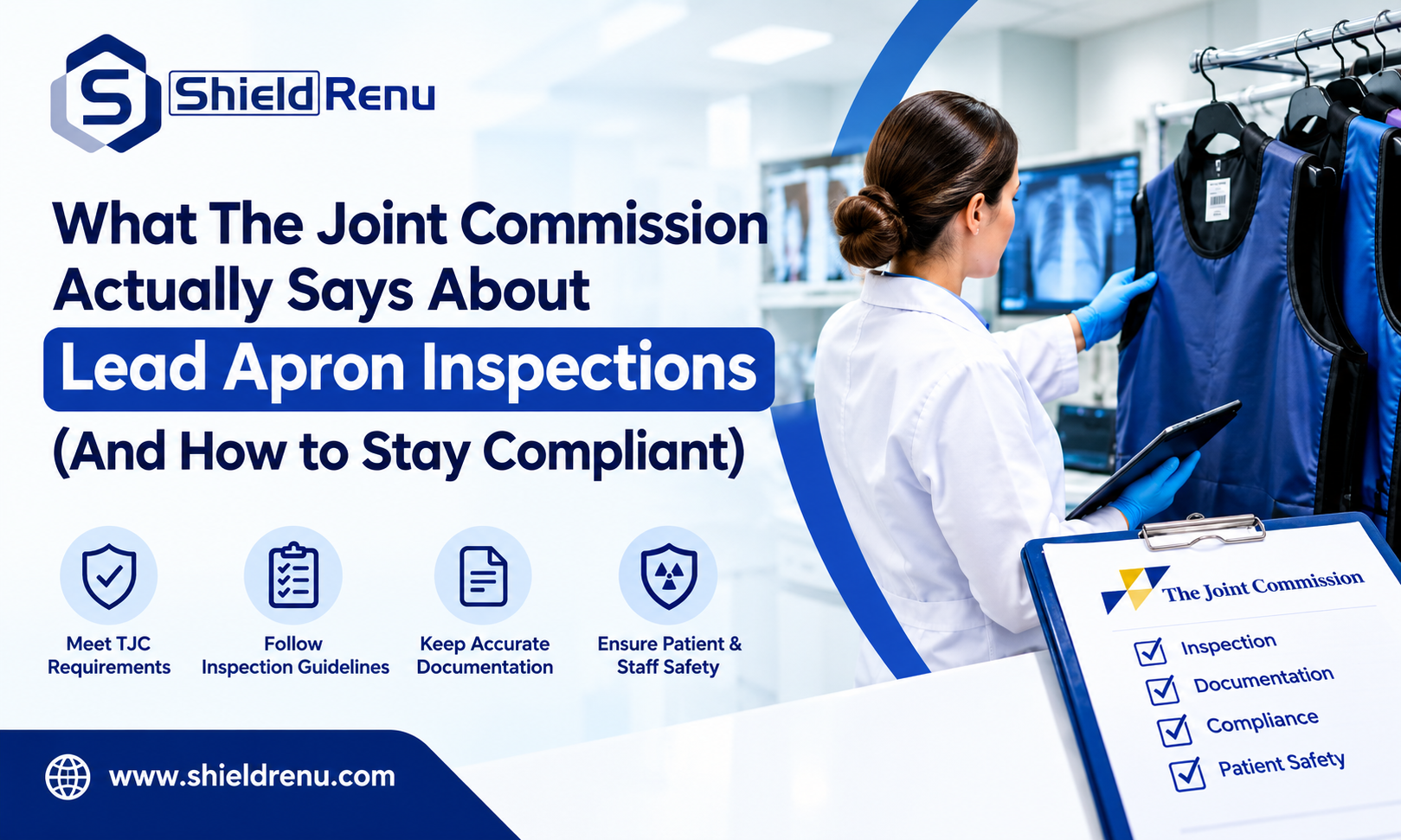
 A Joint Commission surveyor walks into your cath lab. They do not ask for a binder. They walk to the rack, pick up a thyroid collar, turn the tag over, and ask one question: when was this last inspected, and can you show me the record right now?
That single moment is where most lead apron findings are born. Not because the garment was damaged, but because nobody could connect that specific garment to a dated inspection result fast enough.
Here is the part that surprises most imaging managers: The Joint Commission does not publish a standard that says “inspect lead aprons every 12 months by X-ray.” What it actually does is hold you to your own written policy and your own documentation. Understanding that difference is what separates a clean survey from a finding. If you want the condensed version, our TJC lead apron compliance checklist covers the same ground in a printable format.
The short answer
- There is no TJC standard that names lead aprons and prescribes a specific inspection interval or method.
- Leaded PPE is treated as equipment under the Environment of Care standards, which require a defined inventory, defined maintenance activities and frequencies, and documented inspection.
- Annual inspection is the de facto industry standard, driven by state radiation control rules, manufacturer instructions for use, and accepted radiation safety practice.
- Surveyors cite documentation far more often than they cite damaged garments.
- Your written policy becomes your requirement. If your policy says every six months and you inspect annually, you are out of compliance with yourself.
Which standards actually apply to leaded PPE
Lead aprons, vests, skirts, thyroid collars and leaded gloves sit in an unusual spot. They are personal protective equipment, but accreditation treats them the way it treats equipment that has to be inventoried, maintained and documented. Three frameworks converge on them.
1. The Joint Commission Environment of Care standards
The EC chapter requires facilities to maintain an inventory of equipment, define maintenance and inspection activities along with their frequencies, and keep documented evidence that those activities were performed. Environment of Care survey teams routinely check areas where lead aprons are used to verify that the shielding has been inspected within the last year. Nothing in that language is apron-specific, which is exactly why facilities get caught out: the standard points back at your policy.
2. Your state radiation control program
Many state health departments issue their own rules for lead shielding used as PPE, and a number of them do specify annual inspection outright. Where the state rule is stricter than your internal policy, the state rule wins. Check yours before you write your procedure, not after.
3. Manufacturer instructions for use, plus AORN
Garment manufacturers publish their own inspection intervals and handling requirements, and those vary by brand. Perioperative facilities also work against professional practice guidance for radiation PPE handling, storage and cleaning, which we break down in our guide to AORN guidelines for lead apron care. A defensible program reconciles all three sources rather than picking the most convenient one.
So how often should lead aprons actually be inspected?
At minimum, once every 12 months, using radiographic or fluoroscopic scanning, with the result documented per garment. That is the practical floor and the interval surveyors expect to see. We cover the reasoning and the risk of drifting past it in how often lead aprons should be inspected and what happens if you skip it.
Inspect more frequently when any of the following apply:
- The garment already has a known defect that was judged acceptable at the last scan. Small tears do not stay small.
- The garment is in daily high-use service in interventional radiology, cath lab or hybrid OR.
- The garment was dropped, folded, caught on equipment, or returned from repair.
- The garment is being reassigned to a different department or user.
Trigger-based inspection is not optional extra credit. A garment with visible damage should come out of service immediately, regardless of where it sits in the annual cycle.
The five things surveyors actually ask for
When a surveyor engages with leaded PPE, the questions follow a predictable pattern. Be ready with all five.
- A written policy. It must name the inspection frequency, the inspection method, the rejection criteria, and who owns the process. Vague language such as “inspected regularly” is a finding waiting to happen.
- A complete inventory. Every apron, vest, skirt, thyroid collar and pair of gloves in the building, including the ones in the OR, the pain clinic, the dental suite and the storage closet nobody opens.
- A unique ID on every garment. The surveyor is holding a physical apron. If you cannot tie that object to a record in under a minute, the record does not help you.
- Dated results per garment. A department-level summary that says “all aprons inspected in March” is weaker evidence than a per-garment record showing date, method, result and inspector.
- Proof of removal from service. When a garment fails, you need documentation that it was pulled, and that it was repaired or disposed of. A failed apron still hanging on the rack is one of the worst things a surveyor can find.
Where facilities usually get cited
In practice, findings cluster around a handful of avoidable failures:
- Uninventoried garments. Aprons living outside radiology are the single most common gap. Surveyors go looking in exactly those places.
- Tags that faded, tore off, or were written in marker that wore away. The record exists, but it cannot be matched to the garment.
- Records trapped in a spreadsheet on one person’s desktop. When that person is on vacation during the survey, compliance becomes a scramble. We wrote about why spreadsheet-based lead apron inventory management costs facilities more than they think.
- A policy that does not match practice. Rewriting the policy to match what you can sustain is legitimate. Ignoring the policy you already published is not.
- Failed garments left in circulation because nobody decided what to do with them. Our guide on lead apron repair versus replacement after inspection walks through that decision.
If your last survey already produced a lead apron finding, the recovery path is different from routine preparation. Read what to do after a failed Joint Commission survey involving lead aprons for the corrective action approach.
Why visual checks alone will not hold up
A hands-on check catches broken buckles, failed hook-and-loop fasteners, delaminated outer fabric and torn seams. It does not catch what matters most: cracks and micro-perforations in the attenuating layer, hidden underneath intact fabric. Those defects are invisible and cannot be felt through the covering.
The clinical literature is consistent on two points. First, defects are far more common than staff assume in facilities that rely on visual inspection alone. Second, defects progress quickly once they form, with published follow-up studies documenting substantial growth in tear size over a matter of months. A garment that passed a visual check in January can be meaningfully compromised by the time anyone notices anything.
This is why radiographic scanning is the defensible method. Rejection thresholds differ by location on the garment, with much tighter limits over critical organs and on thyroid shields than on seams or the back panel. A full X-ray lead apron integrity inspection is the only way to apply those criteria honestly.
How to build a program that passes every time
- Run a full inventory sweep. Walk every department that uses ionizing radiation, not just imaging. Count everything, including garments in storage and on loan.
- Tag every garment with a permanent unique ID. Barcode tagging turns a rack of anonymous aprons into a searchable inventory and makes the surveyor’s question answerable in seconds.
- Write the policy you can actually sustain. Align it with your state rule and manufacturer guidance, then commit to it.
- Schedule the whole facility on one date. Rolling inspections drift. A single annual event keeps every garment inside the window and gives you one clean compliance date.
- Keep records digital and exportable. More than one person should be able to produce the full history on demand, from any device.
- Act on failures the same day. Pull, document, and replace or repair. Close the loop before the record goes stale.
Cleaning belongs in the same cycle. Improper cleaning agents crack shielding without leaving a visible mark, and contaminated garments are their own infection control exposure, as we cover in the hidden dangers of dirty lead aprons in radiology departments.
How ShieldRenu keeps facilities survey-ready
ShieldRenu brings a fully mobile service unit to your hospital grounds and handles the entire cycle in a single visit. Every garment is X-rayed for hidden defects, barcode tagged and logged into the ShieldRenu inventory app, and cleaned with a hospital-grade bactericidal and viricidal solution. No imaging rooms are taken offline, no staff are pulled from patient care, and no aprons leave your building.
You receive a complete digital report before we leave, with per-garment inspection history, dates and results, exportable for any audit. Our process aligns with Joint Commission, AORN and CDC guidance. See the full range of on-site lead apron services or read more about the ShieldRenu team.
Book a free compliance audit
Do not wait for a surveyor to tell you where your records stand. ShieldRenu will review your current lead apron inventory and inspection documentation and show you exactly where the gaps are. On-site, same day, no contracts. Book a visit with ShieldRenu or call (385) 368-0342.
Frequently asked questions
1. Does The Joint Commission require lead aprons to be X-rayed?
TJC does not mandate a specific inspection method in its standards. It requires that you define your method in policy and document that you followed it. In practice, radiographic or fluoroscopic scanning is the accepted standard of care, because visual and tactile checks cannot detect defects in the attenuating layer. Choosing visual-only inspection puts you in a weak position clinically and legally, even if the policy technically permits it.
2. How long do I need to keep lead apron inspection records?
At an absolute minimum, keep the most recent inspection cycle for every garment currently in service, since that is what a surveyor will ask for. Most facilities retain three years of history, and many retain the full life of the garment. Longer retention helps you demonstrate a trend of compliance and supports decisions about repair versus replacement. Confirm the retention period required by your state and your own records policy.
3. Do thyroid collars and leaded gloves need to be inspected too?
Yes. Every piece of leaded PPE counts, including thyroid shields, vests, skirts, gloves, glasses with leaded lenses and table-side drapes. Thyroid shields are especially important because rejection thresholds for them are far tighter than for a back panel, and they are the items most often left off an inventory. Our lead apron inspection service covers every garment type in one visit.
4. What happens if an apron fails inspection?
Remove it from service immediately and document the removal. Depending on the size and location of the defect, the garment is either repaired by a qualified provider and re-scanned, or disposed of as lead-containing waste through an approved route. Never return a failed garment to the rack pending a decision. The repair or replace decision guide explains when each option makes financial sense.
5. Will The Joint Commission accept digital inspection records?
Yes. Digital records are accepted and are generally stronger evidence than paper, because they are searchable, timestamped, exportable and accessible to more than one staff member. What matters is that the record is complete, per-garment, and can be produced during the survey without delay. More answers are available on our lead apron compliance FAQ page.
