
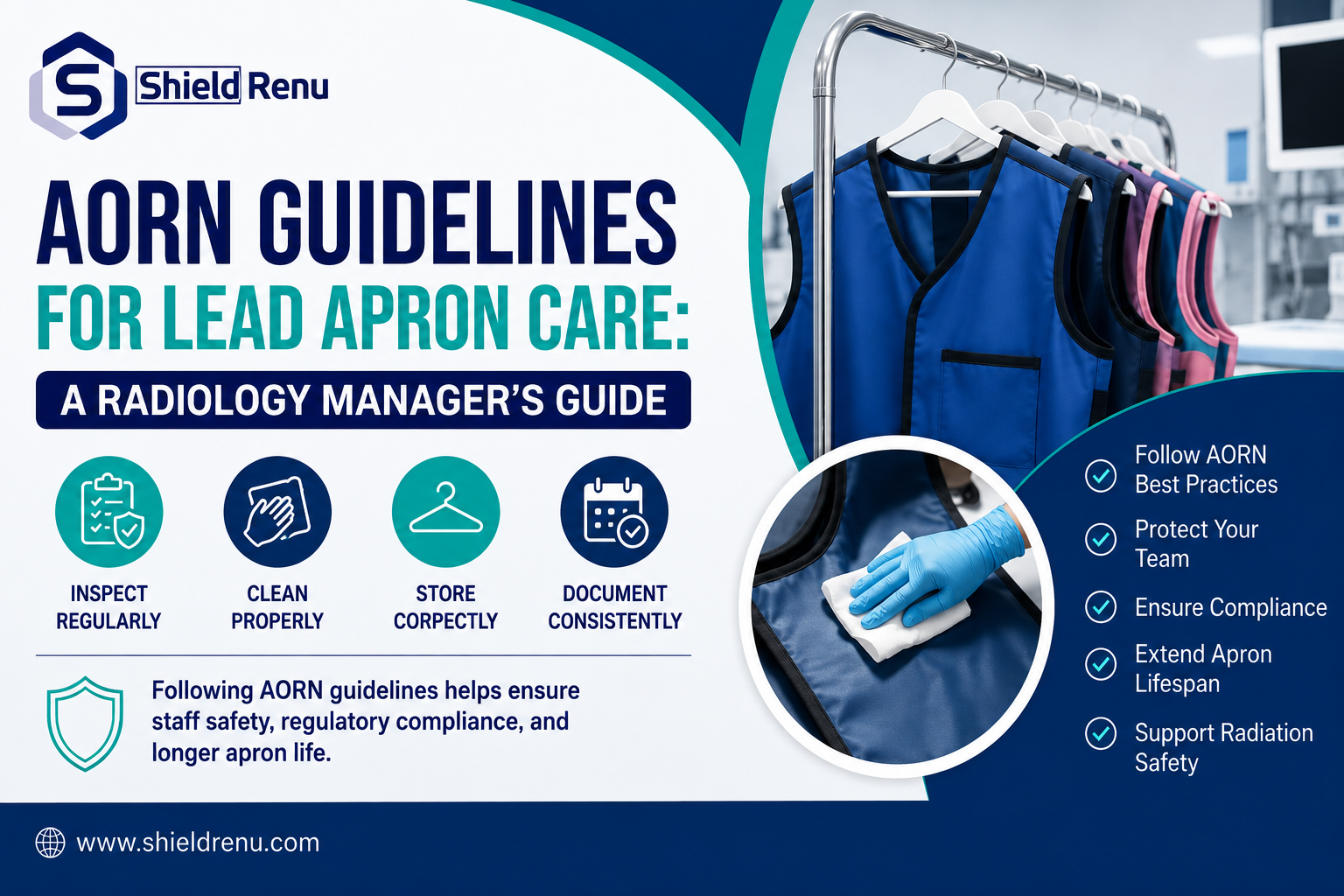
Lead aprons are the single most-used piece of radiation protection equipment in any imaging department, interventional suite, or operating room. Yet in most facilities, they get less structured care than the machines they protect staff from. A lead apron care program built around AORN guidance closes that gap. It gives radiology managers a repeatable framework for cleaning, storage, inspection, and documentation that keeps garments effective and keeps the department survey-ready.
This guide translates AORN’s recommendations into a practical, day-to-day process, covering cleaning and disinfection, storage, annual inspection, and the quality assurance records that tie it all together.
Why AORN Guidelines Matter for Lead Apron Care
The Association of periOperative Registered Nurses (AORN) publishes evidence-based recommendations for radiation safety in perioperative settings, and its guidance on protective apparel is widely adopted well beyond the OR – in diagnostic radiology, cath labs, and interventional radiology. These AORN lead apron guidelines exist because lead aprons degrade in two very different ways: through contamination on the surface, and through hidden damage to the shielding material inside. Either failure mode compromises staff safety, and both are largely preventable with a structured maintenance schedule.
Facilities that treat lead aprons as disposable, low-maintenance PPE tend to discover problems only after an inspection failure, an infection-control citation, or worse, an incident report. A written lead apron maintenance policy modeled on AORN recommendations shifts the department from reactive to proactive.
Lead Apron Cleaning Protocol
A consistent lead apron cleaning protocol is the foundation of radiology lead apron care. Aprons are worn directly against scrubs and skin for hours at a time, and they pass between multiple staff members, which makes them a realistic vector for cross-contamination if cleaning is inconsistent.
- Wipe down aprons after every use with a facility-approved disinfectant, focusing on the collar, shoulder straps, and interior lining where sweat and skin contact concentrate.
- Use quaternary disinfectant wipes or a hydrogen peroxide disinfectant for lead aprons rated for use on vinyl and PVC coverings – avoid bleach or harsh solvents, which break down the outer material over time.
- Schedule quarterly lead apron cleaning as a deeper clean beyond the daily wipe-down, including seams, buckles, and Velcro closures where residue accumulates.
- Perform lead apron deep cleaning whenever a garment is visibly soiled, after known exposure to bodily fluids, or before an apron is reassigned to a different staff member or department.
- Allow full lead apron drying procedures before storage – aprons should never be hung or bagged while damp, since trapped moisture is the leading contributor to biofilm prevention failures in lead aprons.
Lead Apron Disinfection Best Practices
Disinfection is distinct from cleaning: cleaning removes visible soil, disinfection reduces the microbial load underneath it. Both steps matter for radiology infection control, and skipping either one leaves the garment only partially protected.
Choose an EPA-registered disinfectant compatible with vinyl or urethane apron coverings, and follow the manufacturer’s dwell time exactly – wiping a disinfectant off too soon is one of the most common reasons cleaning protocols fail to actually disinfect. For details on how contamination builds up when this step is skipped, see the risks of dirty lead aprons in radiology departments.
Lead Apron Storage Guidelines
Improper storage is one of the fastest ways to shorten the working life of a lead apron. Proper lead apron storage protects the internal shielding layer from cracking and delamination long before any surface damage becomes visible.
- Always use hanging lead aprons correctly – on wide, contoured hangers designed for protective garments, never on narrow wire hangers that create pressure points.
- Never fold lead aprons. Folding creases the internal lead-composite or lead-free shielding material and is one of the most common causes of micro-cracks.
- Store aprons vertically, fully extended, in a dedicated storage area away from direct sunlight and temperature extremes.
- Keep enough hanger spacing that aprons don’t compress against one another, which can bend collars and distort the shoulder shielding over time.
- Label each apron with a unique ID so it can be tracked individually through cleaning, inspection, and repair – a step that also supports lead apron asset management and lead apron inventory tracking.
Radiographic Lead Apron Inspection Requirements
Surface cleaning and correct storage prevent contamination and creasing, but they can’t catch internal shielding defects. That’s what protective lead apron inspection is for, and it’s the part of the program most facilities under-resource.
AORN and most state radiation control programs recommend a combination of visual, tactile, and radiographic inspection:
- Visual lead apron inspection: check the outer covering for tears, exposed lining, worn seams, and damaged buckles or closures at every use.
- Tactile inspection of lead aprons: run hands along the apron surface feeling for lumps, gaps, or thinning that indicate shifted or degraded shielding material.
- X-ray inspection of lead aprons (fluoroscopic apron inspection): performed annually to detect lead apron core defects invisible to the eye or touch, including pinholes, lead apron micro-cracks, and lead apron seam separation.
An annual lead apron inspection using fluoroscopy or dedicated apron X-ray equipment is the only reliable way to confirm structural integrity throughout the entire garment, not just the areas staff happen to touch or see. For a full breakdown of recommended inspection frequency and the consequences of skipping it, see how often lead aprons should be inspected.
Building a Lead Apron Quality Assurance Program
Cleaning and inspection only translate into real lead apron compliance when they’re documented. A defensible lead apron quality assurance program should track, per garment: cleaning dates, inspection dates and results, any repairs performed, and the eventual replacement decision.
Spreadsheet-based tracking is where many departments fall short once the apron count climbs into the dozens or hundreds. If your current tracking system is creating more work than it saves, it’s worth reading why spreadsheets are costing radiology departments on lead apron inventory for a look at what a purpose-built asset management approach solves.
Documentation also needs to map directly to your accrediting body’s expectations. If The Joint Commission is part of your survey cycle, cross-check your process against a TJC lead apron compliance checklist so nothing falls through during an unannounced survey.
Repair, Retire, or Replace: Lead Apron Lifecycle Management
Not every inspection failure means the apron is done. Some defects – a torn seam, a failed buckle, a small covering tear – are repairable. Others, particularly widespread lead apron core defects or shielding thinning across a large area, mean the garment should be retired regardless of how it looks from the outside.
Building clear criteria into your lead apron maintenance policy prevents both extremes: retiring usable garments too early, and keeping compromised ones in circulation too long. For a practical decision framework, see repair vs. replace guidance for lead aprons after inspection.
Putting the Program Together
A complete lead apron care program, built around AORN guidance, rests on four pillars: consistent cleaning and disinfection, correct hanging storage, annual radiographic inspection layered on top of routine visual and tactile checks, and per-garment documentation that supports audits and lifecycle decisions. None of these steps is complicated on its own – the value comes from running all four consistently, for every apron, every year.
For radiology managers building or refreshing this program, the goal isn’t just passing the next survey. It’s making sure every staff member who puts on a lead apron is actually getting the protection that garment is supposed to provide.
Frequently Asked Questions
How often should lead aprons be cleaned?
Lead aprons should be wiped down with a facility-approved disinfectant after every use, with a more thorough quarterly lead apron cleaning to address seams, straps, and closures. Aprons should also be deep-cleaned immediately after visible soiling or fluid exposure.
How often should lead aprons be inspected?
Visual and tactile inspection should happen routinely – ideally before each use – while a full annual lead apron inspection using fluoroscopic or X-ray imaging is recommended to detect internal shielding defects that aren’t visible or detectable by touch. Read our detailed inspection frequency guide for the full breakdown.
Can lead aprons be folded?
No. Folding creases the internal shielding material and is a leading cause of micro-cracks and seam separation. Lead aprons should always be hung on wide, contoured hangers, fully extended.
What disinfectants are safe for lead aprons?
Quaternary disinfectant wipes and hydrogen peroxide-based disinfectants formulated for vinyl or PVC surfaces are generally considered safe options. Bleach and harsh solvents should be avoided, since they degrade the apron’s outer covering over time.
What is the lifespan of a lead apron?
There’s no fixed lifespan – it depends on usage, storage practices, and inspection results. Some aprons remain compliant for many years with proper care, while others fail inspection much sooner due to poor storage or handling. Annual radiographic inspection is what determines whether a specific garment is still safe to use; see our repair vs. replace framework for guidance on making that call.

One Response