
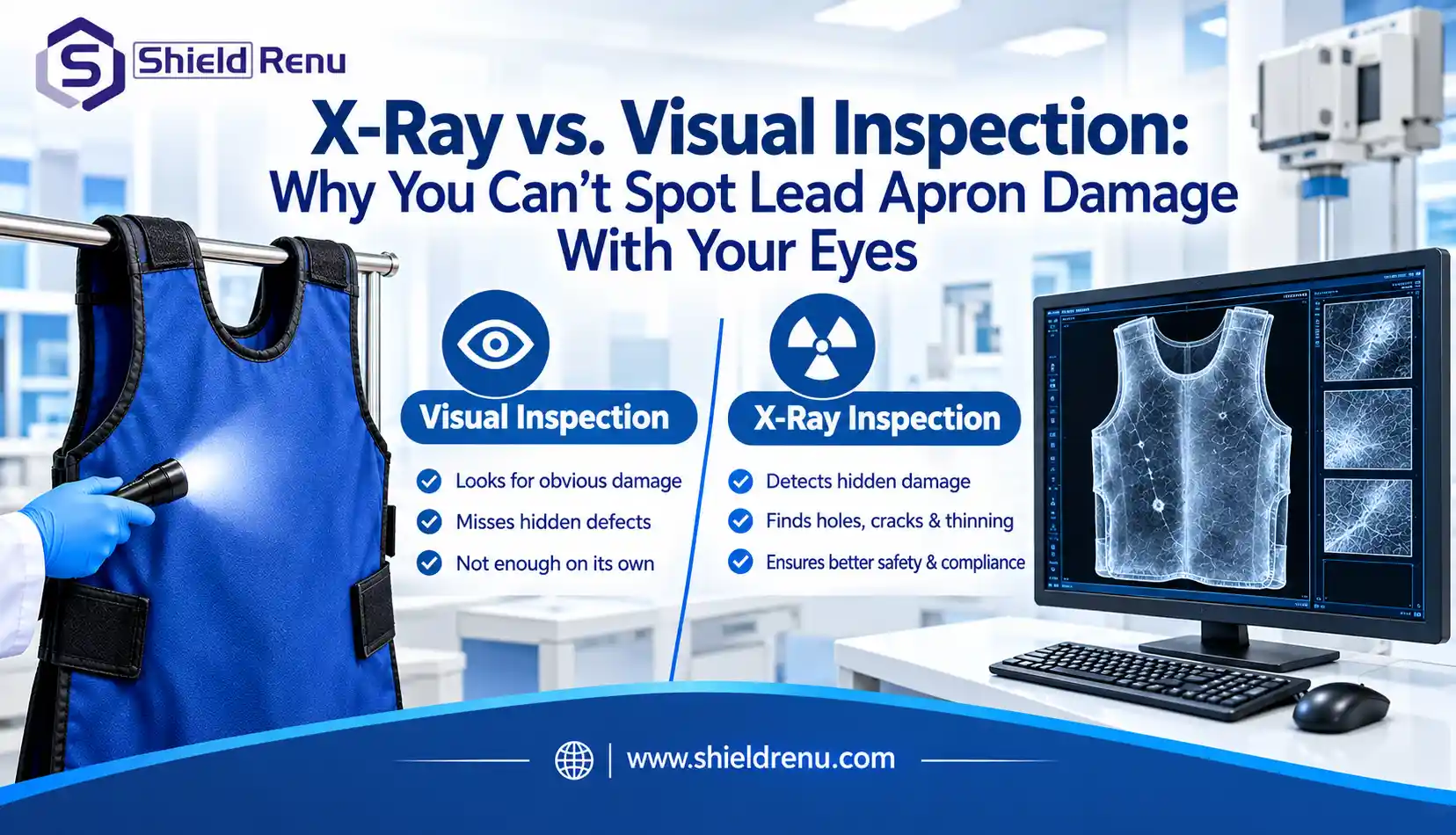
A lead apron can look clean, intact, and perfectly usable on the outside while the radiation-shielding material inside has developed cracks, tears, gaps, or other defects.
That is why visual inspection and X-ray inspection serve different purposes.
A visual inspection can identify obvious external problems such as torn fabric, damaged seams, broken fasteners, or visible deterioration. However, it cannot reliably reveal every defect inside the protective material.
Radiographic or fluoroscopic inspection allows the internal shielding layer to be evaluated for defects that may not be visible or detectable through a basic visual check. Research has also documented cases where visual and tactile inspection found no abnormality while imaging revealed damage to the internal shielding material.
For healthcare facilities that rely on lead aprons for radiation protection, the important question is therefore not simply, “Does this apron look okay?” but rather, “Has the apron been properly inspected for hidden damage?”
What Is a Visual Lead Apron Inspection?
A visual lead apron inspection is the first-line examination of the outside condition of radiation-protective apparel.
During a visual inspection, staff may look for:
- Tears or holes in the outer cover
- Damaged or loose stitching
- Worn seams
- Damaged straps or closures
- Broken Velcro, buckles, or fasteners
- Deformities or unusual bulges
- Evidence of improper storage
- Visible signs of wear and deterioration
Visual inspection is important because external damage can indicate that an apron has experienced significant wear or handling problems.
Healthcare organizations may also perform a tactile inspection by carefully feeling the apron for unusual lumps, thinning, gaps, creases, or other irregularities.
However, a visual inspection should not be treated as proof that the internal shielding is intact.
The shielding material is enclosed within the protective covering. Damage can therefore occur internally without producing an obvious external warning.
Why Visual Inspection Cannot Find All Lead Apron Damage
The biggest limitation of visual inspection is simple: you cannot see through the outer covering of a lead apron with your eyes.
The internal shielding material can deteriorate because of repeated folding, bending, improper storage, frequent handling, age, or mechanical stress.
In one hospital evaluation, visual and tactile examinations did not identify abnormalities in certain aprons, while CT imaging subsequently revealed damage to internal radiation-shielding material.
This illustrates an important point:
An apron can pass a visual check and still require radiographic evaluation.
The same principle is recognized by radiation-safety guidance. The Australian Radiation Protection and Nuclear Safety Agency, for example, notes that protective garments should be tested for integrity defects using fluoroscopy or radiography and that cracks or holes should be identified, marked, and recorded.
What Does X-Ray Inspection of a Lead Apron Detect?
X-ray lead apron inspection uses radiographic imaging to evaluate the internal shielding material.
Instead of relying only on what can be seen from the outside, imaging allows an inspector to identify areas where the protective material may have:
- Cracked
- Torn
- Separated
- Thinned
- Developed gaps or voids
- Deteriorated around repeated stress points
Some defects can be particularly difficult to identify through an external examination.
A 2025 study examining 281 lead aprons using fluoroscopy and X-ray scanning identified both obvious damage, such as tears and cracks, and less obvious defect types. The researchers concluded that periodic fluoroscopic and X-ray examinations are important for identifying invisible damage.
This is why radiographic inspection is an important component of a comprehensive radiological lead apron inspection program.
X-Ray vs. Visual Inspection: What’s the Difference?
The two methods should not be viewed as competing inspection methods. They answer different questions.
| Inspection Method | What It Checks | Main Limitation |
| Visual inspection | Outer cover, seams, closures, obvious damage | Cannot see internal shielding |
| Tactile inspection | Lumps, thinning, irregularities, creases | Cannot reliably identify every internal defect |
| X-ray inspection | Internal shielding integrity | Requires appropriate imaging equipment and trained personnel |
| Fluoroscopic inspection | Internal defects under real-time imaging | Requires suitable fluoroscopy equipment and procedures |
Visual inspection remains valuable because it can identify obvious problems quickly.
Radiographic inspection adds another level of evaluation by allowing the shielding material itself to be assessed.
For that reason, healthcare facilities should have a defined inspection process that incorporates the methods appropriate to their equipment, risk, facility policy, manufacturer instructions, and applicable requirements.
Why Hidden Lead Apron Damage Matters
A lead apron is designed to provide radiation attenuation to the person wearing it.
If the internal shielding has a crack, gap, or other defect, the protective performance may not be uniform across the affected area.
This is particularly important because healthcare professionals may use the same apron repeatedly in environments involving fluoroscopy, interventional procedures, radiography, or other sources of occupational radiation exposure.
A 2025 study found that damaged aprons demonstrated different transmission characteristics from undamaged aprons, reinforcing the importance of identifying defects that may not be obvious from the exterior.
The practical lesson is straightforward:
Do not judge the condition of a radiation-protective apron solely by its appearance.
How Often Should Lead Aprons Be Inspected?
Inspection frequency depends on the facility’s procedures, applicable requirements, manufacturer recommendations, and the way the protective garments are used.
Many radiation-safety programs include routine visual checks and periodic radiographic or fluoroscopic examinations. Some institutional guidance recommends annual inspection, while higher-use environments may establish more frequent checks based on risk and facility policy.
For healthcare organizations developing an inspection program, the process should answer several questions:
- Who is responsible for inspections?
- How are individual aprons identified?
- When was each apron last inspected?
- What inspection method was used?
- What defects were discovered?
- What happens to a failed apron?
- Where are inspection records stored?
- When is the next inspection due?
A consistent documentation process is just as important as the physical inspection itself.
For a deeper discussion of inspection timing and the consequences of missed inspections, see our guide on how often lead aprons should be inspected.
What Should You Do If a Lead Apron Fails Inspection?
If an inspection identifies a potentially significant defect, the apron should not simply be returned to normal use without evaluation.
The appropriate response depends on the nature and location of the defect, facility procedures, manufacturer guidance, and applicable requirements.
A facility may need to:
- Clearly identify the affected apron
- Remove it from service when appropriate
- Document the inspection result
- Determine whether repair is appropriate
- Replace the apron when it cannot be safely returned to service
- Update the facility’s inspection and inventory records
Proper documentation helps prevent a failed garment from accidentally returning to circulation.
It also creates a traceable history for each protective garment.
If you’re evaluating what to do after an inspection failure, our guide on lead apron repair vs. replacement after inspection provides additional information.
Why On-Site X-Ray Lead Apron Inspection Can Help Healthcare Facilities
For facilities managing dozens or hundreds of radiation-protective garments, transporting aprons away from the facility for inspection can create logistical challenges.
An on-site lead apron inspection service can make the process more convenient by bringing the inspection process to the healthcare facility.
Shield Renu provides on-site radiological lead apron inspections, helping facilities evaluate their protective garments without creating unnecessary transportation and handling steps.
The service can include radiographic evaluation, identification of defects, documentation, and digital inspection reporting.
You can learn more about Shield Renu’s radiological lead apron inspection services and how on-site inspection can fit into a facility’s radiation-protection program.
How Inspection Records Support Lead Apron Management
Finding damage is only one part of managing radiation-protective garments.
Facilities also need to know which apron was inspected, when it was inspected, what was found, and what happened afterward.
This becomes increasingly important as the number of aprons increases across radiology, surgery, interventional areas, emergency departments, and other locations.
A structured inventory system can connect individual aprons with inspection history and help facilities maintain better visibility into their protective equipment.
For facilities looking to improve this process, lead apron inventory management explains why organized digital tracking can be more effective than relying entirely on spreadsheets.
X-Ray Inspection and Visual Inspection Should Work Together
The answer is not to eliminate visual inspection.
Instead, healthcare facilities should understand the strengths and limitations of each method.
Visual inspection helps identify obvious external problems.
Tactile inspection can identify certain physical irregularities.
X-ray or fluoroscopic inspection can reveal internal shielding defects that may not be visible from the outside.
Using the appropriate combination gives facilities a more complete picture of lead apron condition.
Radiation-protection guidance similarly emphasizes both routine physical checks and radiographic evaluation when appropriate.
The key takeaway is simple:
A lead apron that looks good is not necessarily an apron that has been proven to be intact.
Why Lead Apron X-Ray Inspection Is Essential for Detecting Hidden Damage
You cannot determine the complete condition of a lead apron simply by looking at it.
Visual inspection remains essential for identifying obvious external damage, but the shielding material inside an apron can develop defects that are difficult or impossible to detect with the human eye.
That is why lead apron X-ray inspection is an important part of a comprehensive radiation-protection and equipment-management program.
For healthcare facilities that want a more reliable way to evaluate their radiation-protective garments, Shield Renu provides on-site radiological lead apron inspection services with digital documentation.
Frequently Asked Questions About Lead Apron X-Ray Inspection
1. Can you see lead apron damage with your eyes?
Not all damage. Visual inspection can identify obvious external problems such as tears, worn seams, and damaged closures, but internal shielding defects may not be visible. X-ray or fluoroscopic inspection can help identify hidden damage within the protective material.
2. Is visual inspection enough for a lead apron?
Visual inspection is an important part of lead apron care, but it does not provide the same information as radiographic inspection. Because internal shielding can be damaged without obvious exterior signs, facilities should follow an appropriate inspection program that includes radiographic evaluation when required or appropriate.
3. What does an X-ray lead apron inspection find?
Radiographic inspection can identify internal shielding defects such as cracks, gaps, tears, and other irregularities that may not be visible during an external inspection. Studies have demonstrated that imaging can reveal damage that visual and tactile examination may miss.
4. How often should a lead apron be X-rayed?
There is no single interval that applies identically to every facility. Inspection frequency should be based on applicable requirements, facility policy, manufacturer guidance, and the level and type of use. Many healthcare programs use periodic radiographic or fluoroscopic evaluation, often annually, with more frequent inspection considered for higher-use environments.
5. Why choose an on-site lead apron inspection service?
On-site inspection allows healthcare facilities to have their protective garments evaluated at their own location, which can simplify logistics and help minimize disruption associated with transporting large inventories of aprons. Shield Renu provides on-site radiological lead apron inspection and digital documentation for healthcare facilities.
